
Regina Trench &
The Victoria Cross


The Capture of the Sugar Refinery at Courcelette by the Canadians
Painted by Fortunino Matania
REGINA TRENCH, 8 October 1916: The day the pipes cut through the Somme
By the first week of October 1916, the Somme had become less an “offensive” than a grinding attempt to prise the German line off the high ground north of Courcelette. General Haig sought to push forward toward Bapaume, and that required taking hard ground: the town of Courcelette itself, the ruins of its sugar factory, and then the formidable Regina Trench. Regina Trench — Staufen Riegel to the Germans — ran along the reverse slope of Ancre Heights, invisible to Allied eyes except through unreliable aerial observation and blind gunnery. Rain and low cloud routinely obscured the target; shellfire, even when accurate, seldom destroyed the trench’s most decisive protection: thick belts of wire that could stop an entire battalion in open ground. The defenders were not raw conscripts, but seasoned German naval infantry of the 4th Ersatz Division. Professional soldiers determined to hold and whose discipline and fire control punished every exposed movement.
The plan — and the gamble
In the History of the 16th Battalion CEF 1914-19 (THE CANADIAN SCOTTISH)
by H. M. Urquhart, D.S.O., M.C., A.D.C., published in 1932 (and the later accounts derived from it) emphasize that the plan for 8 October was built on faith in artillery. The Canadian Scottish would advance behind a rolling barrage, cross the rise toward a trench they could not properly reconnoitre, and trust that the bombardment had done what it was supposed to do: cut wire, bury machine-guns, and leave a shaken garrison. But this was the Somme in autumn — where shell-holes swallowed men, and “wire-cutting” often meant only that gaps existed on paper. The 13th and 16th Battalions attacked on the morning of 8 October with the 14th and 15th in supporting roles nearby.
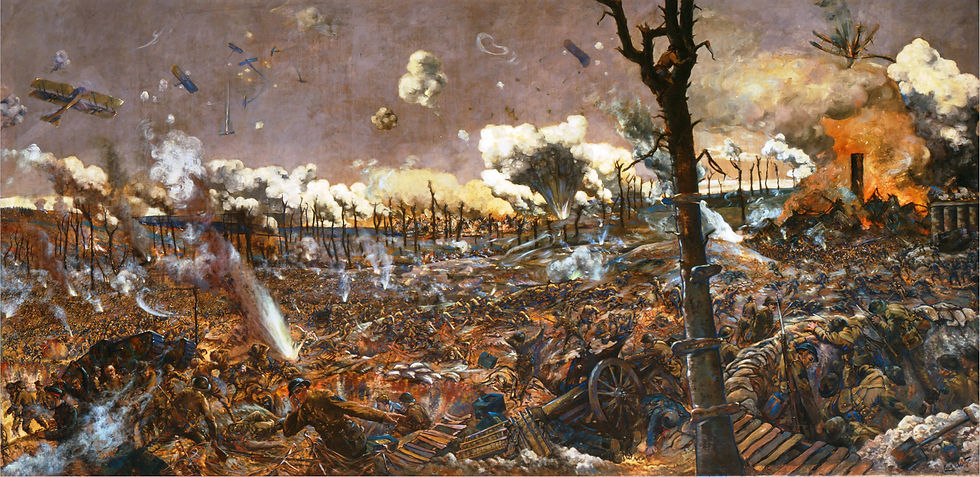
Battle of Courcelette
Soldier and war artist Louis Weirter witnessed Canadian troops' capture of the village of Courcelette, during the Battle of the Somme, in September 1916. He then painted the scene in 1918.
On the night of October 7, 1916, Lieutenant-Colonel Jack Leckie and senior officers gathered to plan the attack scheduled for 4:50 a.m. the next morning. Orders were issued: companies would advance in waves behind a rolling barrage, take Regina Trench, and hold it.
In the rest areas men clustered in small groups waiting for those orders. We can imagine Jimmy amongst some of the other pipers, perhaps John Park, and George Inglis. They stood as Major Lynch approached and passed out Field Service Postcards.
"Here, you'd better send one of these home to your mothers. We go
into the line at 01:00 and attack at 04:50," said Lynch
Jimmy took a card. He crossed out the non relevant lines leaving only, "I am quite well" and "Letter follows at first opportunity." He dated it 7th Oct., 1916, signed it and turned it over to Major Lynch. It was likely while turning in his postcard that Jimmy begged to be taken before the commanding officer.
Now we don't know exactly what was said... Accounts say he implored the commanding officer with tears in his eyes. Based on Jimmy’s writings our production team imagined it went something like this…
Jimmy was brought in the room where Lieutenant Colonel Jack Leckie, Peck, Lynch, and other officers were gathered. We see Leckie waving Jimmy forward and saying, “Private Richardson, I am told you wish to appeal your assigned duties for the day.”
Jimmy, “Sir, I do.”
Leckie, “Mustn’t we all attend to our assignments, no matter how distasteful? If we falter in the carrying out of our orders then we jeopardize the lives of many, do we not?”
Jimmy, "Yes Sir, but I am a piper. Is that not my duty?"
Leckie, "You are needed in the line, Private Richardson. We need your gun and bayonet. A piper playing over the top would face certain death."
Jimmy, "I beg your pardon, Sir, but in the wood at Ypres did we not March towards certain death? Did I not carry the bayonet and advance into the gas? Have we not stood amidst death every day since we arrived on these shores?
Do we not chance death to ensure victory?"
We imagine the Lieutenant Colonel looking intently into Jimmy's eyes then asking, "Private... (then softening) Jimmy... Tell me, why do you pipe?"
Jimmy, "I pipe for them... When the bullets started to fly and the men began to fall, it is the one sound that carries on... It gives them something to follow, something to hold on to...
It tells them home it's just beyond the next trench."
I imagined those officers standing silent, captivated. Jimmy’s eyes brimming with tears.
"Please, Sir. I am a piper."
Perhaps it is here that Major Peck develops thoughts he would later express when he wrote... “I believe the purpose here is to win victories. If we can do this better by encouraging certain sentiments and traditions, then why not?
One of the men might have said , “look at this boy. His passion can have an extraordinary effect on the men's spirits. It's had its effect on me."
Whatever the exact words were the effect was compelling and Lieutenant Colonel Leckie for the first time issued the order for the battalion’s companies to be led by their pipers. Though he cautioned that they would not play over the top but await the signal as they drew close to the enemy's lines.
Four pipers were detailed — one for each company — among them Pipers Hugh McKellar, George Paul, John Park, and James Richardson. Major Lynch, leading No. 1 Company in the first wave, ordered Jimmy to pipe at his side when the time came.
Field Service Post Card
signed by James Richardson
7 Oct., 1916
The Eve of Battle


James Richardson
-1914-

A Piper's Plea
As zero hour approached the men joined thier companies and moved into their positions. Jimmy caught sight of John Park in another company, pipes tucked under his arm. Park raised them in a brief, wordless acknowledgment — brother to brother, piper to piper. Jimmy nodded back, the gesture saying everything neither of them dared say out loud.
The lines moved out into the field, long and snaking. Overhead, shells lit the sky in distant blooms.
At the advanced jumping-off trench, men pressed themselves against the grade, shoulders hunched, breath shallow. Jimmy crouched near Major Lynch, Sergeant Mackie, and Captain Bell.
Artillery screamed overhead and burst on the ridge, dirt and smoke thrown up like waves. Star shells hung and drifted, turning the battlefield into a pale, haunted landscape. Regina Trench lay ahead—five hundred and fifty yards—from thier jumping off point.
On the eastern horizon, dawn hinted at itself in a faint, colorless glow.
Lynch checked his pocket watch, then cried out the order, “Fix… bayonets!”
Metal clattered. Men swallowed.
04:50
Then the artillery volley came — deafening, immense — the rolling barrage moving forward like a wall.
Lynch’s whistle cut the air.
Then the surge over the top. Jimmy was first out, with Major Lynch, Sgt. Mackie, and others on his heels.
From the the History of the 16th Battalion:
"When our barrage started," says Company Sergeant Mackie, who was advancing on the left flank of the leading wave, "Major Lynch, Captain Bell, Piper Richardson and myself went out of the trench. After waiting five minutes we bade goodbye to Captain Bell who was to take over the second line of the Company, and Major Lynch gave the order to advance. The three of us walked in front of the leading line; Piper Richardson on the Major's left and I on his right. The going was easy as the ground was not cut up. About half-way over I commenced to wonder why the piper wasn't playing and crossed over by the side of him to ask the reason. He said he had been told not to play until ordered to do so by the Major.”
Sgt. William (Bill) Mackie
Later described by Col. Cy Peck as
"Big Bill Mackie going up that [Regina] trench like a bull moose."
Into the Fray


Regina Trench
The barrage rolled ahead, explosions stepping forward in a steady march, as if the shells were showing them the way.
Storm clouds thickened, and a light rain began to fall, cold on the face, turning the ground slick and hungry. Then the rise of the reverse slope fell away and the wire appeared.
Sgt. Mackie ran forward and what he saw stopped him cold.
“On coming in sight of the wire I ran on ahead and was astonished to see it was not cut. I tried to locate a way through but could find no opening.”
The wire was everything. It was the difference between a trench taken and a battalion destroyed in the open. Mackie searched, frantic now, but there was no gap—no mercy.
The company came up driving forward into smoke and flying earth. And then—the wire. Men ran into it with the momentum of the charge, hitting it and becoming tangled, rifles caught, bodies snagged. Panic rose like a wave.
“It’s not cut!” someone screamed. “The wire’s not been cut!”
From the German line, machine guns opened and rifles fire erupted.
The sound was like canvas ripping, like iron teeth chewing. Bullets slammed into The men at the wire. Grenades arced from the trench.
Canadians dove into mud, crawled into shell holes, pressed themselves against the earth.
The attack shuddered. It did not collapse immediately—men tried. From the outside of the entanglements some bombed the trench. Others beat down the wooden stakes with rifle butts. But the Germans, protected by their parados, fired with “deadly accurate” rifle fire. Urquhart’s judgment in the Official Regimental History is brutal and simple: “It seemed as if the attacking troops to a man would become casualties.”
Everywhere: chaos, smoke, screaming, the chattering guns.
In one large crater, Major Lynch, Jimmy and Sgt. Mackie huddled at the rim. A dead soldier lay at the bottom like a warning.
“Damn the artillery!” Lynch spat. “And damn the wire!”
“We’ll have to cut it by hand,” Mackie said, already sliding down toward the dead man to yank wire cutters from a pack.
Lynch raised himself just enough to look—
A sniper’s bullet punched into his chest, —blood splashed Jimmy’s tunic and cheek. Lynch collapsed backward, tumbling down the slope into the crater.
Mackie grabbed him, pressed a hand to the wound. Lynch fought for breath, his eyes wide and wild...
Captain Bell and a few men were pinned in another crater, the rim strafed whenever anyone tried to move.
The situation—on the wire, in the mud, in the craters—was hopeless.
...And then Major Lynch’s eyes fixed, and went empty.
Sgt. Mackie looked up at Jimmy and shook his head.
He’s gone.

Will I Give Them Wind?
THE REEL OF TULLOCH
The tune and dance are also known by the shorter Gaelic name "Hullachan," which translates to "uproar." Intentional or not, it seems an appropriate appellation for a tune to rise in"uproar."
Jimmy stared down in contemplation of grief, rage, duty... purpose... until he could hardly breathe. The battlefield roared around him, but for a moment it felt distant, as if the sound had been pushed underwater.
Jimmy’s fingers tightened on the bagpipes at his side.
He looked at Mackie.
“Will I gie them wind?” he asked
Mackie held his gaze, the decision passing between them without need of more words.
“Aye...,” Mackie said. “Gie ’em wind!”
Jimmy’s breathing became loud in his own ears — measured, deliberate. He closed his eyes for a moment, as if he were someplace else, as if he could see beyond the wire and the guns...
Then he stood.
Slowly. Fully. Into the open.
From low in the crater, the men watched as Jimmy swung the pipes under his arm, drones splayed over his shoulder. Tartan ribbons snapped in the breeze behind him.
He stepped up and over the lip of the shell hole.
He struck up the pipes.
The ancient tune "The Reel of Tulloch" cut through the gunfire—not louder, but truer, a sound with backbone... the sound of defiance. The battle noise returned around it, but the pipes threaded through like a living thing.
Jimmy stood alone in the open, shells bursting, bullets stitching the mud around him. A bullet punched through the ribbon between his drones, snapping fabric and leaving him untouched by the hand of providence alone.
And then he began to march.

Piper James Richardson, V.C., 16th Canadian Scottish
at Regina Trench
by J. Prinsep Beadle


Piper James Richardson earns the Victoria Cross
by Alicia Merrill
Men lifted their heads from mud. Eyes widened. Something ignited —astonishment, courage, anger, all of it mixed.
Captain Bell stared from his crater, mouth open. “Good God—look at that!”
He surged up, pistol raised, voice cracking through the noise. “Come on, lads! Level that wire!”
The pipes kept playing.
Men rushed the barrier. They beat stakes with rifle butts, grabbed wire with bare hands and pulled it down.
Inside Regina Trench, Germans heard the bagpipes rising above the din.
An officer lifted binoculars, scanning the smoke—and saw the silhouette of a piper marching into gunfire.
The Highland Regiments had a reputation for being fierce and formidable, men adept at a bayonet charge and fighting with cold steel. One can imagine the fear that might have ran through that officer's mind... He began to cry out and -
A bullet cut him down mid-shout.
A trench mortar landed with a direct, obliterating hit, and fear went through the trench like a contagion.
Near the wire, a Canadian trench mortar team fired again. Jimmy marched past them piping hard, the tune bright and fierce. Shells slammed into Regina Trench, dirt raining down on ducking Germans.
At last, the last coils came down.
A gap opened.
Jimmy piped through it.
And the Canadians surged after him—bent low, running into the trench with bayonets first, bullets hissing overhead.

'Devil in the Kicthen'
Along the parapet, Jimmy played "The Devil in the Kitchen" as Canadians fired at fleeing Germans. A bullet splintered the side of his chanter—and still he played.
Col. Peck later wrote, "There was a young, smooth-faced boy cooly playing up and down the wire in that hail storm of lead... -It screamed the battle call of the most famous soldiers the world has ever known. It thrilled and vibrated through the brave hearts of those men crouching in the shell holes, and stung them to action. They flung themselves on the wire. With kilts torn to shreds and legs lacerated and bleeding, on they come."
Sergeant Mackie reached the lip and saw Germans moving along a support trench that intersected the main line. He dropped in hard.
“Form a blockade, quick!”
Men tore at sandbags, built a wall with frantic haste. A German appeared at the bend and shot a Canadian stacking bags. Mackie returned fire with his pistol.
Jimmy climbed onto the parapet above them. Mackie tossed him a grenade, pointing.
“Jimmy—quick, lad!”
Jimmy caught it, laid his pipes down, yanked the pin, and threw it down the support trench. The explosion folded Germans into smoke and dirt.
Bullets cracked past. Jimmy grabbed a discarded German rifle and fired back, holding the bend while the barricade took shape.
Col. Peck continued in his writing, "The fight is terrific. Where's Richardson? He's with Bill Mackie. Big Bill Mackie's going up that trench like a bull moose. Richardson is with him. He borrows some bombs and lobs them into dugouts, in fact, takes part in the worst of the fighting."
Together, Jimmy and Mackie moved down the trench, clearing doglegs and dugouts with grenades — dark mouths in the earth that spat fire until the blast silenced them. Each time they approached a dugout, Jimmy tossed a bomb, the muted thump followed by smoke rolling out. Mackie checked for life.
They kept moving.
At one dugout, two wounded Germans staggered out, hands raised, pleading not to be shot. Mackie’s pistol came up, anger and adrenaline urging him to finish it.
“Sergeant,” Jimmy said, stopping him, steadying him. “Let me have ’em.”
Mackie hesitated — then nodded. Jimmy checked them for weapons, keeping his rifle on them while Mackie pressed on.
Further down the line, the 14th Battalion struggled to erect a defense of sandbags, duckboards, and wire. Ammunition was thin; bombs were gone. Communication had vanished.
Mackie arrived at the worst of it and threw a grenade into a wave of advancing Germans.
“Bomb!” Makie warned.
The Canadians reacted and dove for cover. The explosion halted the German assault.
An officer of the 14th dusted himself off. “Glad you showed up with some bombs.”
Mackie upended his pack—empty.
“And we’re running out of ammunition,” the officer said.
Jimmy arrived with the prisoners and forced them to sit. Fresh Canadian soldiers came running — Lieutenant Hart among them, Sergeant Slessor too.
Orders snapped. Prisoners were handed off. Men threw themselves into fortifying the defense. Then the German marines hit again — hard men, moving like they meant to reclaim the trench.
The sandbag wall tumbled.
Gunfire erupted in the cramped space. Slessor went down wounded. Mackie was shot through; blood poured and he slumped against the trench wall.
Lieutenant Hart emptied his revolver into grey uniforms. Canadians surged with bayonets in brutal, close struggle. Jimmy drove his blade into a man and turned, rushing back to Mackie.
“It’s not good,” Jimmy said, seeing the wound. “He’ll bleed out if he doesn’t get help.”
Hart looked at the line, at the men, at the trench they could barely hold. “Alright. You’ll have to help him back to aid.”
“Can you manage these prisoners as well? I can’t spare the help.”
“Aye,” Jimmy said.
Hart shoved the prisoners over the top. A soldier guarded them. Then Hart helped Jimmy lift Mackie up and over.
“Tell them we can’t hold without support,” Hart said, voice tight.
Jimmy waved the Germans forward with Mackie’s gun and began the stagger back across No Man’s Land.

Chanter and stock from the recovered battlefield pipes played by Jimmy at Regina Trench. Note the bullet splintered section near the bottom of the chanter.


German Prisoners captured by Canadians in the storming of Regina Trench. October, 1916.
They moved through gunfire and bursting bombs, passing the wire littered with bodies — men who had been alive when dawn began. Halfway across, they dropped into a large shell hole for cover.
Mackie cried out, pain tearing through him. He was pale from blood loss. Jimmy gave him a canteen, checked the wound again, hands shaking despite himself.
Two stretcher bearers slid into the hole with a soldier.
“We saw ya comin’,” one said.
They rolled Mackie onto the stretcher with practiced care.
Jimmy’s eyes darted back toward the trench line — toward the place where, in the roar and smoke, he’d laid his precious bagpipes.
“I left my pipes,” Jimmy said.
Mackie’s face twisted. “No!”
“Jimmy, ya canna be goin’ back!” a bearer pleaded.
Jimmy’s voice came low and immovable. “I canna leave my pipes.”
The bearers lifted Mackie. Mackie tugged weakly at a sleeve, trying to pull the stretcher to a stop.
“Wait for him,” he rasped.
Jimmy put both hands on Mackie’s, forcing the trembling grip to hold for one more second.
“I’ll get my pipes,” Jimmy promised, “and be right behind ya.”
Mackie tried to grasp him firmly, but his bloody hand slipped free.
Jimmy turned.... and walked back into the battlefield.
From Mackie’s fading perspective, the world dulled at the edges. The sound thinned... and Jimmy — small against the torn earth and the smoke and the merciless guns — moved farther away, step by step, until he became a figure swallowed by the morning haze, drifting toward blackness as Mackie's consciousness failed him.


Piper James Richardson, VC
by Alicia Merrill
Back inside the trench, the world narrowed to mud, timber, smoke, and bodies. “It was mostly hand to hand,” Urquhart writes in the Official History. The German Marines fought viciously. “No quarter was asked or given by either side.” Bombers died in heaps; “all the 16th bombers in these sections of the line were killed or wounded.” Grenades ran so low that captured German stick bombs had to be used to keep the enemy moving back. The trench was “well revetted… in good condition” and stocked with food, but the Canadians who held it were starving for something far more urgent: ammunition, bombs, and men.
Dawn broke—a clear autumn morning—and the battalion could finally see how few they were.
After the count, the number present in the trench was “only ninety-eight,” including four officers and five senior NCOs. Nearly everyone else had become a casualty at the wire. Only two Lewis guns and a captured machine gun were firing. Bombs were exhausted except for German stick bombs. Small arms ammunition reserves could only be stripped from the dead. Yet a front of over 360 yards had to be held.
Hart, the senior officer present, decided they had no option but to remain. A block was thrown up on the left, but the left flank was “completely in the air.” Beyond it, the enemy trench stretched half a mile, “well manned,” with wire “eight to ten feet wide, untouched by shell fire.” For the rest of the day, the Germans hammered the left with periodic bombing attacks. Slessor was wounded and captured and died three days later.
Messages had to be carried overland under fire—of all the runners, only two got through, one each way. One of Hart’s messages begged for bombs and ammunition and asked the guns to be turned on the enemy trench beyond the block.
Headquarters complied. The 15th Battalion carried ammunition forward “in a gallant manner under enemy fire.” Artillery smothered the enemy trench for a few hours. But by mid-afternoon, both flanks were open. Hart and Bevan concluded what the field had been screaming since the wire proved uncut: they could not hold.
“Then,” Hart wrote, “we decided to fall back… I took the responsibility… of ordering the Battalion to retire.”
The retirement was done “with light casualties,” men slipping back a few at a time to the jumping-off trench. By five or six p.m. the survivors were out. The day’s fighting, from dawn to dusk, had been of “no avail.” The losses among officers and NCOs were so heavy Urquhart believed marksmen had been placed in the wire specifically to pick off leaders.
And in the midst of those losses, one young piper’s deed remained like a flare that never quite went out.
Urquhart states plainly: Piper Richardson was not originally detailed. He pleaded to go. He played for ten minutes in front of the wire at the moment it seemed the entire attack would become casualties. And “he was killed a few hours after he performed the gallant deed… which earned a posthumous Victoria Cross.”
The Victoria Cross was officially Gazetted two years later on October 22, 1918
"For most conspicuous bravery and devotion to duty when, prior to attack, he obtained permission from his Commanding Officer to play his company “over the top.” As the company approached the objective, it was held up by very strong wire and came under intense fire, which caused heavy casualties and demoralised the formation for the moment. Realising the situation, Piper Richardson strode up and down outside the wire, playing his pipes with the greatest coolness. The effect was instantaneous. Inspired by his splendid example, the company rushed the wire with such fury and determination that the obstacle was overcome and the position captured. Later, after participating in bombing operations, he was detailed to take back a wounded comrade and prisoners. After proceeding about 200 yards Piper Richardson remembered that he had left his pipes behind. Although strongly urged not to do so, he insisted on returning to recover his pipes. He has never been seen since, and death has been presumed accordingly owing to lapse of time"
- Ninth Supplement to The London Gazette of 18 October 1918. 22 October 1918
The Victoria Cross Medal features a cross pattee with a dark brown finish owing to the metal sourced from a cannon captured from the Russians during the Crimean War. The front displays the Royal Crown surmounted by a lion guardant. Below the crown, a scroll bearing the inscription: FOR VALOUR.
A straight bar (ornamented with laurels), slotted for the ribbon, has a V-lug below. A small link joins the V-lug to a semi-circular lug on the top of the cross. The recipient’s rank, name and regiment are engraved on the reverse of the mounting bar.
On the reverse of the cross medal are raised edges with the date of the act engraved within a raised circle. 8 Oct. 1916, in Jimmy's case.
But the meaning of 8 October, 1916 and Regina Trench is written in those few words spoken in a shell hole at the wire — simple words that carry the weight of everything: “Will I gie them wind?”
Because what Jimmy gave them was not only wind for the pipes. He gave wind to men who could not breathe under fear. He gave a sound that cut through machine guns and confusion. He gave the battalion forward motion when leadership was dead and wire was uncut. And for ten minutes — ten impossibly long minutes — he stood where men were not meant to stand, and played where no sane man would play, until others could rise.
That is why Regina Trench is remembered with his name. That is why the Victoria Cross bears it.
And that is why, more than a century later, the story still lands like a hand on the heart: a boy from Bellshill and Canada, with nothing but pipes under his arm, walking along the wire in the rain, giving his comrades wind.


