
The Journey of Richardson's
Battlefield Pipes
From the mud of the Somme
In the spring of 1917, months after the Canadians had fought and withdrawn from the shattered ground around Courcelette and Regina Trench, a broken set of bagpipes lay in the open on the Somme battlefield— mud-stained, battered, and silent. They had apparently lain exposed for four or five months before coming into the hands of Major Edward Yeld Bate, an Oxford-educated British Army chaplain. Rather than leaving the pipes to be lost Bate preserved them.
After the war he returned to Scotland, took a teaching post at Ardvreck School in Crieff, Perthshire - Scotland and when he retired in 1931, he placed the pipes in the school’s library display case with a simple card: "Bagpipes found laying on the battlefield for several months near Courcelette. February 1917.” For decades they remained in that display case — an anonymous relic of the Somme, their mud and scars still clinging to them, their owner unknown.

Edward Yeld Bate
- at Ardvreck in the 1920's -

The Pipes in the School Library

16th Battalion Pipes from Ardvreck in the Christie home laid against the WWI Lennox tartan kilt brought by Roger McGuire for comparison.
That long silence ended when in 2001 the internet and the world wide web came to Ardvreck and one parent happened to be a piper.
Tomas Christie, with children at Ardvreck participating in the school's pipe band, became fascinated by the battered instrument in the display case and especially by its unusual tartan — a bag cover and ribbon pattern he could not connect to any known Scottish regiment. He saw an opportunity to show the students how the internet could be used as a research tool. He posted an inquiry online, hoping to trace the regiment and find the piper who had carried them. The question reached the right person: Pipe Major Roger McGuire of The Canadian Scottish Regiment, one of the few people able to recognize the rare intersection of date, place, and tartan. McGuire suspected the cloth was not Scottish regimental tartan at all, but the obscure Lennox tartan associated with the pipers of the 16th Battalion (Canadian Scottish) — a battalion famously comprised of four Highland units or militias and forced to find a shared identity in a numbered battalion. While the soldiers refused issued khaki kilts and fought to retain their original tartans, the battalion’s war pipes were decorated in Lennox to unify the pipe band under one pattern, following a tradition that dicated the tartan honor the family of the commanding officer's wife. Christie’s question had set in motion a quest of discovery.
With the support of the Canadian Club of Vancouver — then led by Andrew Winstanley — and a committee of patriotic supporters, McGuire travelled to Scotland to examine the pipes in person. His initial inspection was not based on photographs. He carried with him a First World War kilt from the regimental museum specifically to compare its Lennox tartan to the tartan on the pipes’ bag cover and ribbon. The match was compelling: whatever else remained uncertain, the pipes could be tied to the 16th Battalion. McGuire also noted the visceral details that made the artifact so powerful — mud still present, staining on the ivory that might even have been blood — and how pristine the tartan remained on the inside of the cover, protected from the battlefield’s filth. For a piper, the experience was almost overwhelming. Holding an instrument that might have sounded over one of the war’s most terrible battlegrounds was to feel history in your hands.

Pipe Major Roger McGuire
in the Christie Home investigating the pipes from Ardvreck

A Tale of Two Pipers

James C. Richardson
- 1914 -

Exhumation and Reburial report
But even with the tartan link established, a crucial problem remained — one that demanded caution rather than certainty. Two pipers from the 16th Battalion were lost at Regina Trench. One was James Cleland Richardson, the youngest piper in the regiment whose act of playing under fire would later earn the Victoria Cross. The other was Piper John Park, killed in the same battle and never recovered. Park’s disappearance meant he had no known grave; his name is recorded on the Vimy Memorial, one of the many missing in France. Richardson became famous in death, while Park slipped toward obscurity. That fact created a genuine fork in the artifact story: if a set of 16th Battalion pipes was recovered at Courcelette after Regina Trench, could those pipes have belonged to Park instead?
McGuire remained publicly cautious about linking them to Richardson specifically. As he noted at the time, “the odd thing about this story is that the other piper killed the same day—Corporal John Park—was never found and has no known grave.” He also pointed out that Park, like Richardson, had been born in Scotland and that his next of kin remained there, making his story easier to lose in Canadian memory.
McGuire further clarified a common source of confusion: during the war, the numbered 16th Battalion was at times referred to administratively as part of the “Manitoba Regiment” while passing through Winnipeg, a reflection of Canada’s early decision to organize overseas units by number rather than by traditional regimental identity. This administrative complexity meant that Park’s and Richardson’s pipes would have been indistinguishable on the basis of battalion issue alone.
At that point, McGuire summarized the situation bluntly: there was still a “50–50” chance the pipes had belonged to either piper. Both men had gone forward piping; both were listed as wounded or missing on 8–9 October 1916; both were later declared missing, presumed killed.
We know Piper Park was never found and has no known grave, but Piper Richardson does. It is not entirely clear when Richardson was found. It seems likely that he lay where he fell, at least for a time, and — inevitably, amid the chaos of battle — key details seem to have been lost. When, exactly, was he first buried, and by whom?
It is, of course, possible that his remains lay for months in a part of No Man’s Land that was inaccessible during the fighting, only to be reached later when the ground changed hands or the front shifted.
Continued research led to Richardson’s original burial and subsequent exhumation. In correspondence with the Commonwealth War Graves Commission (CWGC) in 2003, the team was told that Richardson had been exhumed from plot 57c.M.16.A.4.6 on June 15, 1920. McGuire was able to establish that Richardson’s grave had been identified by the cross placed there by the Graves Registration Unit at the time of the initial burial, though the CWGC held no record of who was actually present when he was first laid to rest. An exhumation report could not be obtained. Richardson’s remains, along with those of other fallen men, were later reinterred at Adanac Cemetery, not far from the original plot.
One possibility, though unproven, is that the Major Bate may have been present at Richardson’s initial burial. We know that Bate left the card with the pipes in the display describing when and where they came from. Yet Bate himself left no written statement that directly links him, in his own words, either to Richardson’s burial or to the moment the pipes were discovered.
As an educated chaplain, Bate might plausibly have kept journals or letters describing the circumstances of recovery. When exactly were the pipes taken off the field? Were they collected by himself, or passed to him by others? Did he recover them in connection with the fallen piper? The answers could have strengthened the chain of evidence dramatically. Yet, despite efforts over the years, no journal or personal record by Bate referencing the pipes has surfaced.

John Park
- 1914 -


16th Battalion Pipe Band - Salisbury Plain, England
- 1914 -
Richardson and Park back row top left side by side
This is where Paradigm Motion Picture Co. became integral the journey — not only as storytellers, but as investigators. Paradigm’s research team, led by Ian Williams (VP of Development and a piper himself), spent years following every thread: regimental archives, museum holdings, battlefield records, and family histories. Paradigm also pursued Bate’s descendants and made inquiries through institutions where such personal papers might appear. To date, no Bate journal has been found. The “how” of the recovery remains partly mysterious.
But Paradigm’s work helped solve what the tartan and provenance alone could not: the identity of the pipes’ original owner. While searching through regimental archives, Alanna Williams located a key photograph of the pipe band during training at Salisbury Plain, England — an image in which James Richardson and John Park stand side by side, each holding his own set of pipes.
It was Ian Williams and his experience as a piper, whose critical eye noticed the most telling difference. Under magnification, the ivory chanter soles — specifically the shape and size of the bottom opening — were clearly different between the two sets. Under close analysis, the two sets of pipes show subtle differences. When the battlefield pipes were compared against the Salisbury Plain image, the match was exact for the pipes held by James Richardson and not those carried by John Park. The same differences can be identified in a photo of the full pipe band taken at Valcartier. This photographic analysis resolved what tartan, location, and provenance alone could not. The identification of Richardson's pipes moved from “possible” to certain.

Sharpened close up of Richardson and Park from the Salisbury Plain image. The chanter sole disparity visible.
Homecoming

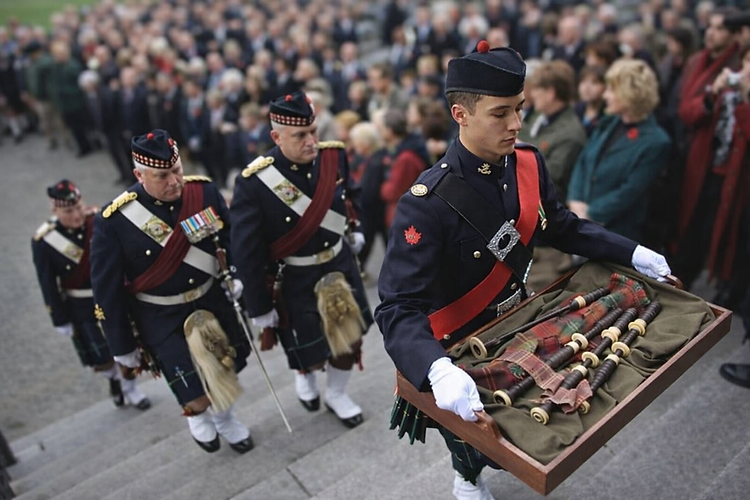
Premier Gordon Campbell with the pipes on the steps of the Legislative Assembly 8 November, 2006
REPATRIATION CEREMONY
With the question finally settled, an anonymous donor purchased the pipes on behalf of the people of Canada. In October 2006, a Canadian delegation formally received them from Ardvreck School.
On 8 November 2006, after years of research, coordination, and negotiation, the pipes were brought home to Canada. Their return was marked by a public repatriation ceremony at the Legislative Assembly of British Columbia in Victoria. In a deliberate and deeply moving choice, the pipes were carried into the building by Josh MacDonald, a young cadet of The Canadian Scottish Regiment — about the same age Jimmy had been when he belonged to the cadets before going off to war. The symbolism was unmistakable: the pipes had done what James could not... They came home.
Today, Richardson’s pipes stand as a rare, tangible witness to a moment that could otherwise feel like legend: a young piper stepping into gunfire with nothing more than courage and the defiant music of his homeland.
Now his memory is carried forward by what survived—mud, tartan, wood, and the painstaking work of people who refused to let the story fade.

"Even in thier silence his pipes call us still and, as the pipes so often do, thier call both breaks our hearts and lifts our spirits with pride. They call us still... They call us to remember."
Gordon Campbell, OC OBC
Premier of British Columbia
Repatriation Ceremony
8 November, 2006


